Featured

Are Electric Cars the Future of UK Roads?

The rise of the automobile, fit with a fossil-fuel-chugging internal combustion engine, has seen with it unsustainable behavioural changes at a wider societal scale. Acting in line with other post-industrial human technological advancements, we have gradually arrived at the “uh-oh” phase wherein policymakers are desperately attempting to undo decades of environmental damage and increasingly aware consumers are appealing for change.

So, where does this leave the state of the UK fleet? It appears as if one solution stands out amongst the crowd of emerging technologies: electric cars. They are slowly pushing competition out of the market and paving the way for their prioritisation through government subsidies and positive consumer attitudes. The UK government has placed increased taxes and charges on diesel vehicles due to their historical notoriety of being highly polluting, causing the diesel market share to plummet to 42.0% in 2018. However, this shift has partly caused average CO2 emissions for new cars to rise 2.9% from 2018 to 2019, despite being 31.2% lower than in 2000. Thanks to evolving technologies and research, diesel combustion engines have been gradually becoming less carbon emission intensive, helping the government and businesses reach emission objectives. Steadily becoming more popular with the promise of affordable, accessible, and most importantly sustainable options compared to conventional vehicles, the UK has seen a 236.4% increase in battery electric vehicles (BEV) from 2018 to 2019. With the promise of rapid growth of the electric vehicle sector, many questions have been raised by critics and consumers alike as to whether or not electric cars really are the solution to the problem, or if instead they pose new threats to our environment.

Measuring the overall emissions of electric vehicles is a difficult and complex task. We know that the greatest proportion of emissions in BEV production comes from the high amounts of electricity needed in battery manufacturing. There are multiple factors which contribute to the extent of emissions: composition of the battery (some materials are more energy intensive), source of electricity (coal, renewables etc), and the size of the battery for determining vehicle range. Lithium ion battery production, the standard used for BEVs, rare earth resources to be extracted and refined which is energy intensive in itself. Whilst most lithium ion batteries in Europe are sourced from Japan and South Korea currently which have similar energy generation sources to most of Europe, coal-powered electricity production still accounts for 25-40% of the electric grid.

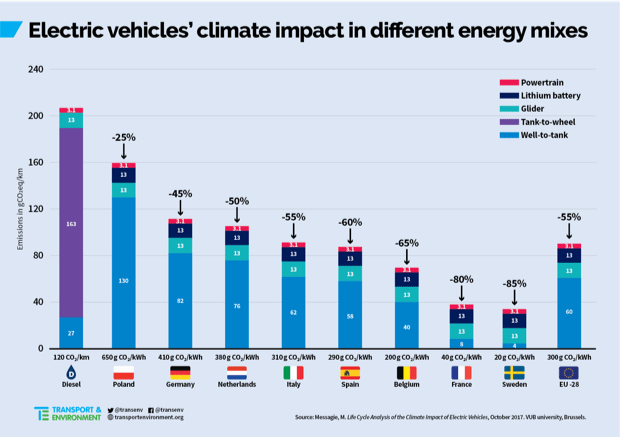
Despite the pitfalls of battery production, lithium ion battery technologies continue to advance meaning the cost of electric vehicle manufacturing is falling. With its rising popularity, this means there will be more electric vehicles accounting for fewer road emissions and travelling farther with any given unit of energy compared to conventional vehicles. Although battery production in South Korea and Japan aren’t any greener than Europe, many countries in the continent are competing with China, who use more coal, by building major battery production facilities, maintaining at least a standard of sources of energy. Crucially, BEVs in Europe generally produce 29% less carbon emissions compared to even the most efficient internal combustion engine vehicles, as shown by the figure below.

A screenshot of a cell phone

Description automatically generated
Source: https://theicct.org/sites/default/files/publications/EV-life-cycle-GHG_ICCT-Briefing_09022018_vF.pdf

Finding the balance between the environmental gains and losses of BEVs is a vital consideration manufacturers and governments across the globe must take. Further development and research into battery recycling and second life opportunities is incredibly important in furthering the reduction of overall carbon footprint throughout the entire supply chain. Moreover, by 2030 the carbon intensity of electric grids are estimated to drop by over 30%; if this occurs globally this will result in approximately 17% lower battery manufacturing emissions. Even plug-in hybrid vehicles have lower life-cycle carbon emissions than ICE vehicles in Europe.
A screenshot of a cell phone

Description automatically generated
Source: https://www.transportenvironment.org/press/electric-cars-emit-less-co2-over-their-lifetime-diesels-even-when-powered-dirtiest-electricity

With all of these factors in mind, ultimately BEVs are the solution to a more environmentally friendly passenger vehicle that is accessible to the global market. The key to its success lies in grid decarbonisation, advancement of recycling and reuse technologies, and the affordability of BEVs to the average person seeking to buy a passenger vehicle.

Is Afforestation Worth the Hype?

Trees. We all know and love them (I hope). They provide a beautiful landscape, eerie settings, nostalgic childhood memories, and most importantly oxygen. With the advent of global anthropogenic climate change, focus has dramatically shifted to our woody friends. The cries of “plant more trees” and “trees are our future” echo in the distance as illegal loggers in the Amazon slave away, ever-frequent wildfires rage, and urban planners clear woodlands and forests. It’s a quintessential solution to the abundance of CO2 in the atmosphere: photosynthesis takes in CO2 and releases oxygen. So, what are we doing about it?

The Conservatives released the Budget in March 2020, pledging to plant 30 million trees every year, which is a big leap up from May’s parliament. Currently, woodland covers 3.19 million hectares of the United Kingdom, with each square metre converting 1.7kg of CO2 per year and releasing 1.2kg for respiration. Despite acting as effective carbon sinks in this respect, risks posed by droughts or wildfires to forests and woodland are troubling as they could ultimately make woodlands release any carbon sequestered. Droughts would cause the trees to die and decompose, which releases CO2 through microbe respiration, and fires release the carbon stored in wood and leaves through burning.

Australian wildfires ravage the country, above shown in 2013.
Source: https://www.businessinsider.com.au/wildfires-rage-in-australia-2013-1

As such, grasslands may become a more viable option for stable and effective carbon sinks as carbon is stored underground in the roots and soil, despite having lower sequestering capabilities, as captured carbon is not released by fires and droughts largely do not affect stores. In this sense, grasslands are more adaptive to an uncertain future riddled by extreme weather changes. Critically, grassland conservation need not replace tree planting efforts, rather they have the potential to be used in tandem with each other and provide insurance should weather changes cause trees to release carbon due to drought, fires and/or disease.

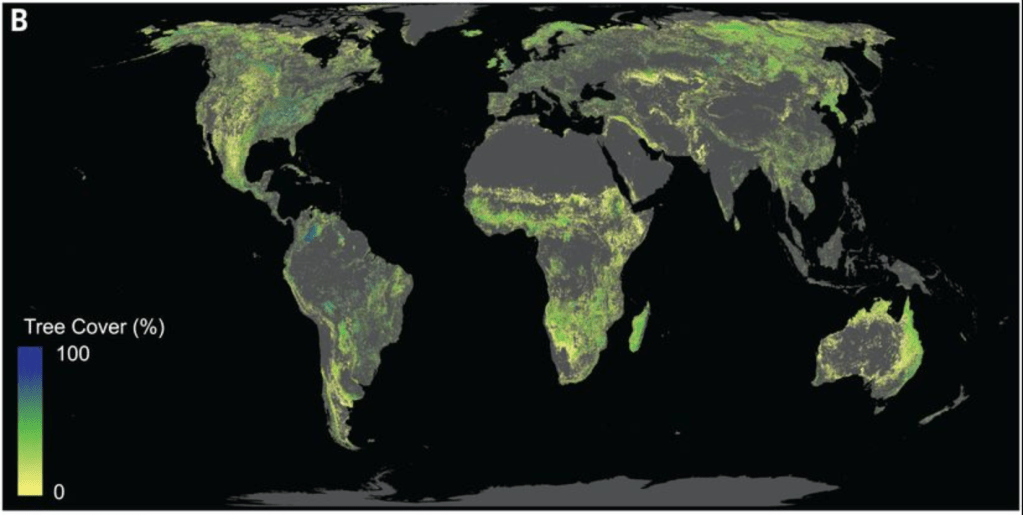
For now, at least however, the UK government is focusing on tree planting. This follows the trend of other countries worldwide pledging ambitious afforestation targets. Or so it seems. Tree planting capabilities are high however many countries pledge <50% of achievable potential, not taking into account private or publicly owned land. An estimated 3.2 billion ha more forested land could be grown, totalling about two thirds of total terrestrial land. Whilst around half of this figure is found in croplands and urban areas, the remainder most importantly lies in previously degraded land defined by grasslands, degraded bare soils, and sparse vegetation. Taking into account land needed for human development and sustenance, researchers estimate 0.9 billion ha of potential canopy cover could be found outside of urban regions and cropland. This would result in 205GtC (gigatonnes carbon) being held once forests and woodlands in this area matured over several decades. Consequently, around 300GtC of global anthropogenic carbon could be captured from the atmosphere, deeming ecosystem restoration as a highly effective and entirely realisable solution to climate change. However, restoration planning is difficult because prediction is marred by uncertainty in Earth’s climatic future hence running models based off multiple Earth System Models and RCP scenarios is vital.

Global potential tree cover available for restoration representing an area of 0.9 billion ha of canopy cover.
Source: https://science.sciencemag.org/content/365/6448/76?hwshib2=authn%3A1584411402%3A20200315%253A2d0d9dcb-299e-4d83-9c11-0735f6b6157e%3A0%3A0%3A0%3A3VQgESB3oiMwpENoQLvlwQ%3D%3D

In short, yes, trees can massively contribute to the reduction of atmospheric CO2. Despite this however, the UK government, even taking into consideration the recent Budget announcements, has decided to permit the building of HS2 rail link. This project has been deemed as the “single biggest threat to the UK’s ancient woods” by the Woodland Trust, claiming 108 of them are at risk of degradation or loss. On the contrary, grasslands offer an effective insurance method and tree planting continues to become popular with it becoming not only a governmental concern, but also more recently a profitable business venture (8 Billion Trees for example). Perhaps the Conservative UK government will take a leaf out of such initiatives’ books – we can only hope.

Will Becoming a Vegan Really Make a Difference?

Humans need food – it’s an unavoidable fact of life that has existed for hundreds of thousands of years. As such, the world’s population size and demand for food go hand-in-hand: by 2050, global demand for feed, food and fibre is predicted to rise by 70% alongside a projected population size of 9.8 billion. Over the years, there has been a transformation of consumer dietary habits, with developing countries experiencing around a 300% increase in meat consumption. This can be put down to growing wealth of individuals in such nations, as this figure follows the global trend of a 62% rise in consumption of meat. Although more people are arguably living a life more sought after, the foregoing increase in meat consumption carries with it the ambiguity of the extent of environmental damage.

If the UK experienced a nationwide citizen switch to veganism, we would observe at least a 26% decrease in greenhouse gas emissions. Less cropland would be necessary to feed the livestock, who would have caused land degradation though soil compaction, land clearing and risks of overgrazing. Thus, plant-based diets are intrinsically less susceptible to loss of arable land, reduction of biodiversity, and contribute less to global climate change.

The land used for animals feed crops could be put to better use; instinctively, we could consider using this land for crops harvested for human consumption, however this land would allow the exploration of using biofuels on a greater scale. This would permit a decrease in fossil fuel combustion and subsequently a reduction in greenhouse gas emissions. In this sense, animal-based diets are limiting human distancing from anthropogenic climate change by dominating productive land which offer a multitude of potential solutions.

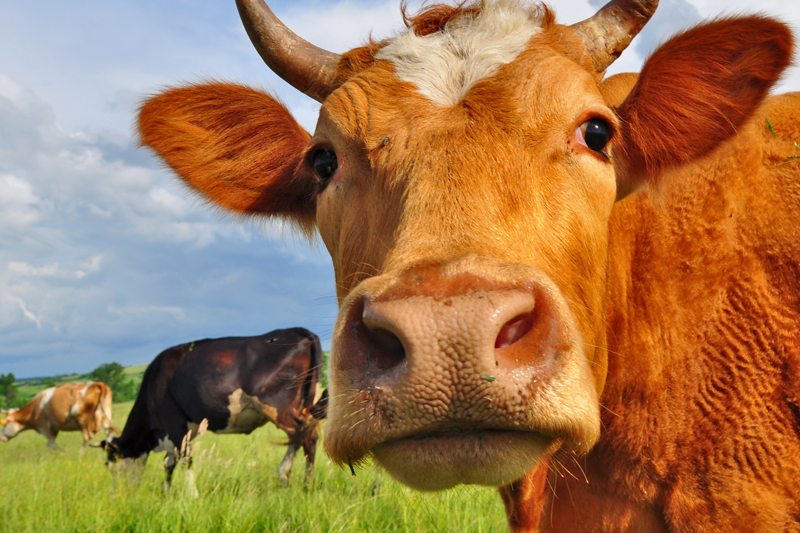
I can’t stay angry at that face, it’s not your fault you’re destroying the planet.
Source: https://www.countryfinancial.com/en/insurance/farm-ranch/livestock.html

On the other hand, more crops don’t necessarily mean the eradication world hunger. Farming methods must change; intensive farming is increasing in popularity across the globe, including but not limited to genetic modification and chemical biological control such as fertilisers, which are directly correlation to processes of eutrophication and algal blooms which wreak havoc in ecosystems. The idea of intensive farming is to produce the highest yield possible, however the rate of growth of major cereal crops plummeted from 3.2% to 1.5% over 60 years. Furthermore, GM crops run the risk of becoming resistant and invading native flora, proving a detriment to biodiversity and natural ecosystems.

Meat eaters are able to continue a more familiar diet whilst reducing their carbon footprint thanks to plant-based meat alternatives, such as soya products or Quorn – a popular meat alternative brand – which contains mycoprotein. Quorn is highly efficient, needing 2kg of wheat per 1kg of Quorn, compared to 12-24 kg of feed needed for 1kg of beef. On the contrary, 53% of genetically modified crops were soy, posing the question of the extent of damage on the environment if demand continued to rise.

Mo Farah, Great British national treasure, is a keen advocate for veganism and a representative for Quorn
Source: http://www.fordcapriforum.com/forum/viewtopic.php?f=10&t=48949

Whilst reducing meat intake offers a solution to global climate change, dietary shifts aren’t certainly viable due to public bias surrounding diet and maintenance of natural environmental quality, stemming from protein production. However, sustaining mixed diets necessitates vast areas of land to meet demand. Nonetheless, whether or not plant-based diets or mixed diets are maintained, land will inevitably degrade to the point of infertility if poor management continues to be practiced. Ultimately, the dynamic nature of consumer attitudes toward eating meat, the continuing prosperity of developing countries, and the increase in food demand corresponding with global population size have each contributed to anthropogenic climate change and the deterioration of global biodiversity. A switch to veganism is one step any individual can make to mitigate the climate crisis, so why not give it a try?

Design a site like this with WordPress.com
Get started