Trees. We all know and love them (I hope). They provide a beautiful landscape, eerie settings, nostalgic childhood memories, and most importantly oxygen. With the advent of global anthropogenic climate change, focus has dramatically shifted to our woody friends. The cries of “plant more trees” and “trees are our future” echo in the distance as illegal loggers in the Amazon slave away, ever-frequent wildfires rage, and urban planners clear woodlands and forests. It’s a quintessential solution to the abundance of CO2 in the atmosphere: photosynthesis takes in CO2 and releases oxygen. So, what are we doing about it?
The Conservatives released the Budget in March 2020, pledging to plant 30 million trees every year, which is a big leap up from May’s parliament. Currently, woodland covers 3.19 million hectares of the United Kingdom, with each square metre converting 1.7kg of CO2 per year and releasing 1.2kg for respiration. Despite acting as effective carbon sinks in this respect, risks posed by droughts or wildfires to forests and woodland are troubling as they could ultimately make woodlands release any carbon sequestered. Droughts would cause the trees to die and decompose, which releases CO2 through microbe respiration, and fires release the carbon stored in wood and leaves through burning.

Source: https://www.businessinsider.com.au/wildfires-rage-in-australia-2013-1
As such, grasslands may become a more viable option for stable and effective carbon sinks as carbon is stored underground in the roots and soil, despite having lower sequestering capabilities, as captured carbon is not released by fires and droughts largely do not affect stores. In this sense, grasslands are more adaptive to an uncertain future riddled by extreme weather changes. Critically, grassland conservation need not replace tree planting efforts, rather they have the potential to be used in tandem with each other and provide insurance should weather changes cause trees to release carbon due to drought, fires and/or disease.
For now, at least however, the UK government is focusing on tree planting. This follows the trend of other countries worldwide pledging ambitious afforestation targets. Or so it seems. Tree planting capabilities are high however many countries pledge <50% of achievable potential, not taking into account private or publicly owned land. An estimated 3.2 billion ha more forested land could be grown, totalling about two thirds of total terrestrial land. Whilst around half of this figure is found in croplands and urban areas, the remainder most importantly lies in previously degraded land defined by grasslands, degraded bare soils, and sparse vegetation. Taking into account land needed for human development and sustenance, researchers estimate 0.9 billion ha of potential canopy cover could be found outside of urban regions and cropland. This would result in 205GtC (gigatonnes carbon) being held once forests and woodlands in this area matured over several decades. Consequently, around 300GtC of global anthropogenic carbon could be captured from the atmosphere, deeming ecosystem restoration as a highly effective and entirely realisable solution to climate change. However, restoration planning is difficult because prediction is marred by uncertainty in Earth’s climatic future hence running models based off multiple Earth System Models and RCP scenarios is vital.
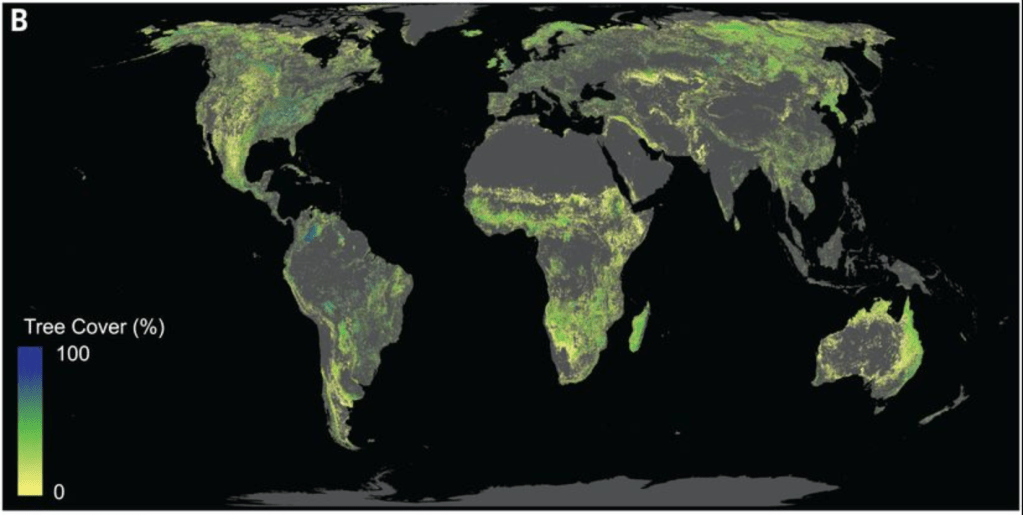
Source: https://science.sciencemag.org/content/365/6448/76?hwshib2=authn%3A1584411402%3A20200315%253A2d0d9dcb-299e-4d83-9c11-0735f6b6157e%3A0%3A0%3A0%3A3VQgESB3oiMwpENoQLvlwQ%3D%3D
In short, yes, trees can massively contribute to the reduction of atmospheric CO2. Despite this however, the UK government, even taking into consideration the recent Budget announcements, has decided to permit the building of HS2 rail link. This project has been deemed as the “single biggest threat to the UK’s ancient woods” by the Woodland Trust, claiming 108 of them are at risk of degradation or loss. On the contrary, grasslands offer an effective insurance method and tree planting continues to become popular with it becoming not only a governmental concern, but also more recently a profitable business venture (8 Billion Trees for example). Perhaps the Conservative UK government will take a leaf out of such initiatives’ books – we can only hope.
 A Renewable Future